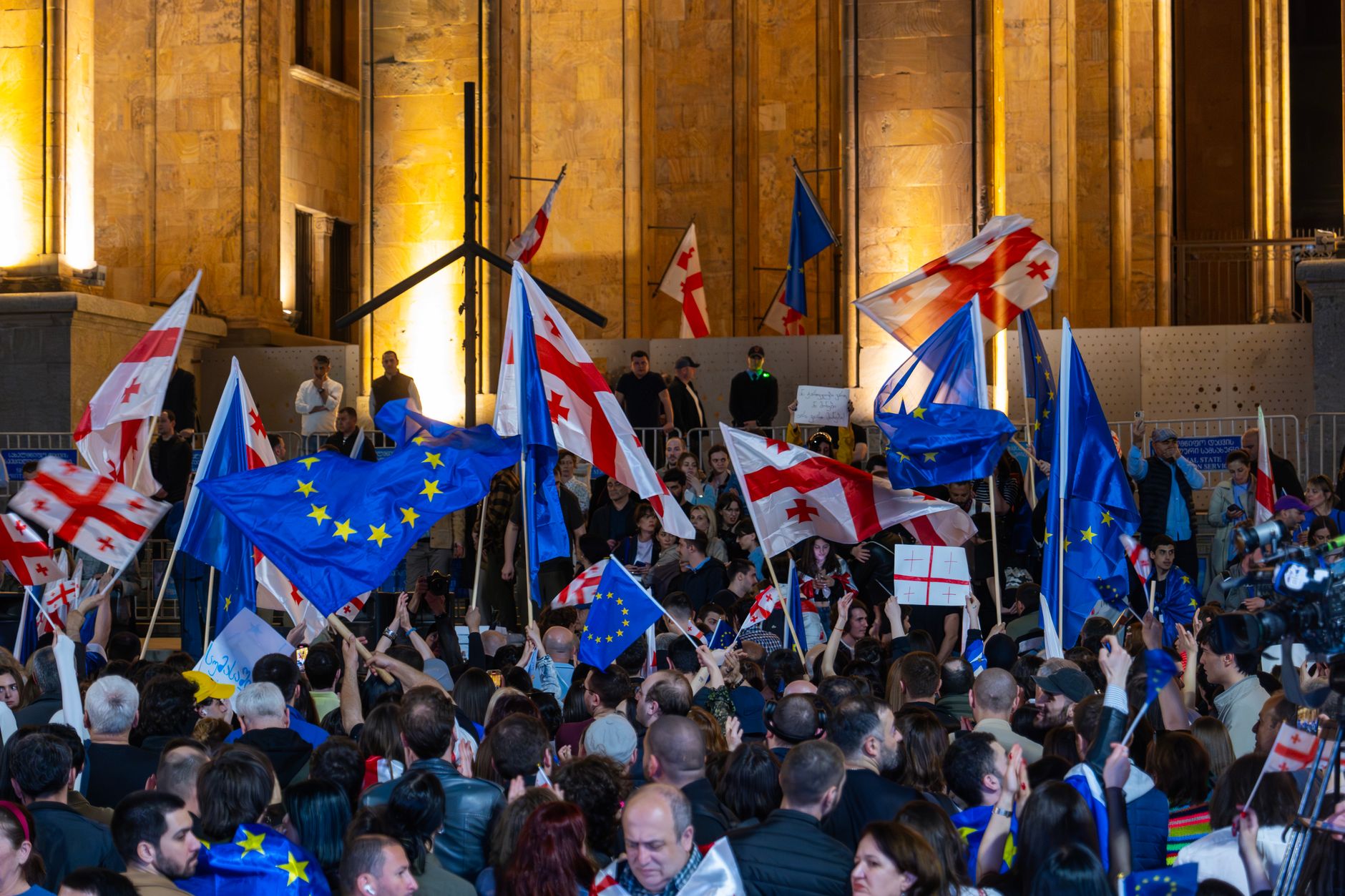
Is it just me, or does Georgia seem to be stuck in the world’s most exhausting political love triangle? Not with a person – with an entire direction. For years now this small, mountainous, achingly beautiful country has been caught between two very different futures, and depending on who you ask in Tbilisi, it’s either about to finally break free or about to be quietly pulled back in for good. If this was a kdrama, I think Georgia would be the young girl madly in love with the school’s best student, doing everything she can to catch his attention, while the slightly toxic, slightly cool bad boy tries to with her over.

But let’s rewind a little, because you can’t really get the drama without the backstory: Georgia was part of the Soviet Union until 1991, and even after independence it never really got a clean break from Russia. The two fought a brief but brutal war in 2008 over the breakaway regions of Abkhazia and South Ossetia, after which Russia recognised both as independent states and Georgia lost roughly a fifth of its own territory in the process. There have been no formal diplomatic relations between the two countries since. Not exactly the kind of ex you can stay friendly with, right?
And yet! Cut to 2012, and the party that’s been running Georgia ever since – Georgian Dream – was founded by a billionaire, Bidzina Ivanishvili, who made his fortune in Russia. For years Georgian Dream officially kept chasing the EU dream (the country was even granted official EU candidate status in December 2023, a genuinely big deal), while somehow, slowly, also drifting the other way – closer to Moscow’s orbit in tone, in legislation, in instinct, even while insisting out loud that Europe was still the goal. It’s the political equivalent of texting your ex while telling everyone you’ve happily moved on.
Then 2024 happened, and the whole thing came to a head. The government pushed through a “foreign agents” law that critics said was lifted almost directly from Russia’s own playbook for silencing independent media and NGOs, sparking huge protests. Then came a deeply contested parliamentary election in October, which Georgian Dream claimed to win outright, but which international observers described as neither free nor fair. And then, the real gut-punch: in late November 2024, the government announced it was suspending EU accession talks entirely, until 2028 at the earliest, and turning down EU funding along with it.
People did not take that quietly! Protests broke out that night and, honestly, they’ve never really stopped – we’re talking well over a year of demonstrations in Tbilisi, sometimes met with water cannons and tear gas, hundreds arrested, journalists targeted, and now genuine political prisoners, including a Sakharov Prize laureate. The European Parliament has gone as far as refusing to recognise the legitimacy of the current Georgian parliament and president. Georgia’s ties with NATO are, by most accounts, now effectively frozen too – it wasn’t even present at this year’s summit.
When I visited the country, I found a place that was painfully divided between a majority, especially made up of young people, yearning for the progressive EU, versus a smaller minority still reminiscing the old soviet times. Poll after poll shows something like 86% of Georgians support joining the EU, and roughly three-quarters back NATO membership too. Speaking with people there, I truly felt the discontent and resentment of a population whose lives are actively undermined by their own government.
And Russia, for its part, doesn’t even need to do much anymore – it’s not really escalation at this point, more a slow, patient tightening. Just this year, Russia signed a deeper “allied integration” treaty with South Ossetia, one that now lets Russian citizens hold office there, and the region’s own leader stepped down specifically to go work for Putin, calling closer integration his “cherished dream.” Abkhazia has pushed back a bit harder on full absorption, but it’s still economically tangled up with Moscow through ports, rail lines, energy. Meanwhile Georgia keeps getting more entangled with Chinese capital too, which, fascinatingly, might end up mattering just as much long-term as anything happening with Brussels or Moscow.
So what actually stands between Georgia and the EU, you may ask? From what I’ve seen, despite the strong push towards integration with the EU from the population, things like foreign agents law, the disputed elections, the crackdown on protesters and press, a legislation that runs directly against EU values, and now a government that’s explicitly said it won’t even talk accession again until 2028, are really making it tough to get there. The EU, for its part, has made it pretty clear reforms have to come first, and coordinated sanctions on Georgian officials are now genuinely on the table.
What will happen next honestly feels tied to things way bigger than Georgia itself – how the war in Ukraine eventually resolves, how long a government can keep governing against the clearly stated will of most of its own population, whether the protest movement outlasts the crackdown or the other way around. I don’t think anyone, including people who live there, quite knows how this ends. I am not directly involved in these politics so all I can talk about is my own experience and what I’ve heard and read about it, but my feeling is this love triangle will unfortunately last for a while longer, and I am not really sure of the outcome.
Have you ever visited Georgia? What are your thoughts on this topic? I’d love to hear about it.
As always, wishing you all a lovely day,
Elena
