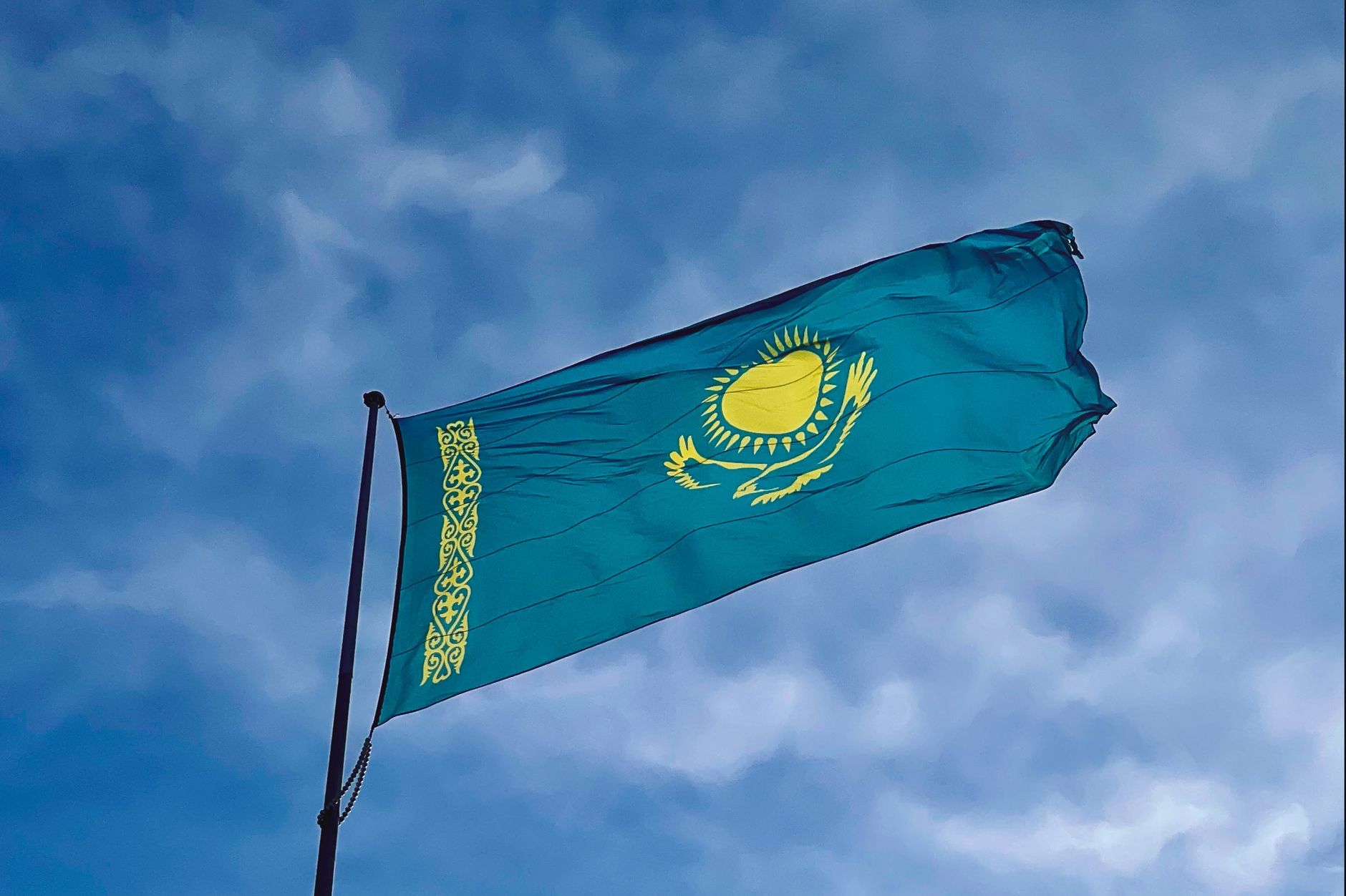
Did you know Kazakhstan is basically younger than my parents? Independent since 1991, which sounds obvious once you say it out loud, but it wasn’t until I was actually standing in Almaty that it hit me how recent all of this is. So I figured, before writing anything else about the place, I should actually try to understand it a bit; but the more I dug, the more I realised how much history is quietly sitting underneath every city I wandered through without knowing it.

Fun fact: did you know that the blue in Kazakh flag represents the sky – aka peace?
Let’s start at the beginning-ish. Before it was anything resembling a country, this was steppe – a vast, open, endless piece of land, where nomadic people followed their herds across it with the seasons, living in yurts that could be packed up and moved in a matter of hours and never settling anywhere specific. The Kazakh Khanate itself only formed in the 15th century, when a handful of Turkic and Mongol tribes banded together, and that nomadic backbone – the hospitality, the horses, the whole “the steppe belongs to everyone and no one” ethos – is still something you can feel today, even in a city as glassy and modern as Astana!
Then, obviously, along came Russia. Starting in the 19th century, waves of Russian settlers moved onto Kazakh land, and it only intensified once the Soviets took over – collectivization in the 1930s triggered a famine so severe it’s estimated to have killed somewhere between a fifth and a third of the entire Kazakh population. Pretty wild. And then in the 1950s came the Virgin Lands campaign, where Khrushchev shipped in hundreds of thousands more Slavic settlers to farm the steppe, permanently reshaping who lived where. Karaganda (yes, the city I keep raving about in another post), was also home to one of the largest Gulag camp systems in the Soviet Union, which honestly recontextualized a lot of what I felt while I was there, whether I fully clocked it at the time or not. In fact, you can still visit one of these gulags – currently renamed as the KarLak museum, just outside of Karaganda.
By independence, Kazakhstan was barely majority-Kazakh: in fact, it turns out Russians made up something like 40% of the population at points during the Soviet era, and a lot of them didn’t leave after it fell as they had by then become assimilated into the Kazakh land. Since 1991 that’s shifted a lot, partly through emigration and partly through demographics, and today ethnic Kazakhs are back to being a strong majority, with ethnic Russians, still a meaningful and rooted minority, mostly concentrated in the north, currently make up somewhere around 14-18% of the country. And in fact, I could notice while travelling through Kazakhstan how this relatively high percentage still causes a lot of internal divide among people. But that’s a whole other topic I’d like to talk about in depth in a separate post…
So, nowadays? It’s genuinely fascinating, and a bit tense, if I’m honest. Kazakhstan is in the middle of switching its entire alphabet from Cyrillic to Latin, a process that started rolling out a few years back and won’t fully wrap up until 2031 –-which is as much a symbol of national identity as it is a practical spelling reform. And politically, President Tokayev has been threading an incredibly careful needle since Russia’s invasion of Ukraine, refusing to recognise Russia’s claims on Ukrainian territory, occasionally making a point of speaking Kazakh instead of Russian in meetings with Putin, while still keeping the countries closely, deeply economically tied, because geography and decades of infrastructure don’t just disappear because you’d like them to.
While in Kazakhstan, I could truly feel this political struggle as I talked to people and learned more and more about it. It felt more like a country quietly, deliberately writing its own story after a very long time of someone else holding the pen, although the way in which this is currently being done is, in my humble opinion, quite debatable. 😛 You hear Russian and Kazakh both, often in the same conversation, sometimes from the same person mid-sentence – and there’s something genuinely moving about watching a place figure out, in real time, who it wants to be.
Anyway. I came here to write about mountains and canyons and ended up down a historical rabbit hole instead – but I don’t think you can really understand a place until you understand what it’s been through to get here, can you?
Have you ever gone down a research hole like this for a place you visited? Tell me I’m not the only one!
As always, wishing you all a lovely day,
Elena
